



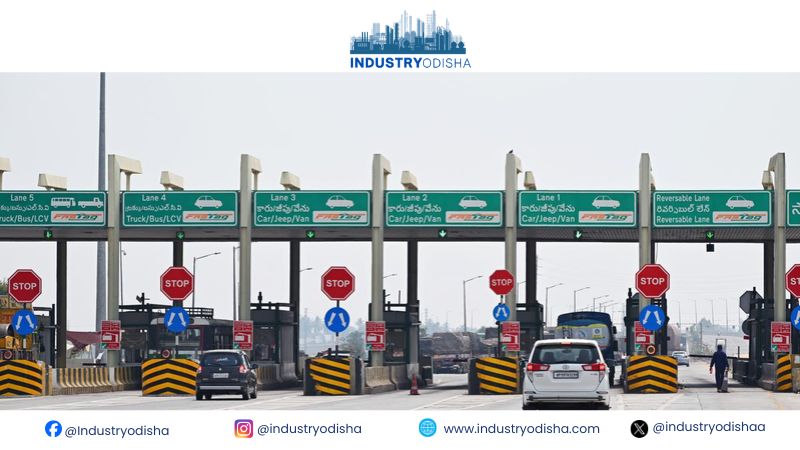
Industry Odisha Bureau, Aug 19: India’s toll collections reached ₹67,400 crore in fiscal year 2026 recently. Toll plaza transactions surged to 3.81 billion, driven by FASTag-enabled digital collections. This expansion reveals how digitized highway toll collection has reshaped India’s infrastructure landscape. Yet the revenue patterns show a deeper structural shift toward operator concentration increasingly.
The National Electronic Toll Collection network expanded from roughly 300 toll plazas in 2016. By March 2026, NETC operated 1,160 toll plazas across India’s national highways systematically. This tenfold expansion, driven by mandatory FASTag and expressway construction, accelerated highway monetization.
Toll plazas concentrate heavily in northern and western India reflecting economic geography. Rajasthan, Uttar Pradesh and Maharashtra together operate over one-third of national toll plazas. Rajasthan leads with 159 toll plazas, followed by Uttar Pradesh’s 136 toll plazas.
India’s highest-revenue toll plazas concentrate overwhelmingly on the Golden Quadrilateral highway network. All fifteen highest-grossing toll plazas in FY26 were located on this corridor exclusively. The Delhi-Mumbai corridor alone dominates, with nine of fifteen plazas operating on this route. These nine plazas generated approximately ₹3,200 crore, nearly sixty percent of top-fifteen revenue.
Shahjahanpur toll plaza in Rajasthan led national collections with ₹443 crore in FY26. Operated by Pink City Expressway, this figure exceeds the national average of ₹58 crore. The highest-revenue plazas show average transaction values 44 percent above the national average.
Private vehicles generated remarkably disproportionate revenue patterns compared to their transaction volume shares. Private vehicles represented 62 percent of transactions yet only 23 percent of toll revenue. This disparity reflects lower private-vehicle toll rates compared to commercial vehicles charged nationally. At Shahjahanpur, private vehicles pay ₹195 one-way while trucks exceed ₹665 charged. Vehicles with four or more axles face toll charges exceeding ₹1,000 per crossing.
The FASTag annual pass, introduced August 2025, appears to have shifted private-vehicle economics. Private-vehicle transactions continued rising while revenue from these users declined during recent quarters.
Private operators generated approximately half of India’s total toll revenue in fiscal year. Yet these private operators controlled only 27 percent of toll plazas nationally existing. This divergence suggests private participation has strategically concentrated on high-traffic, high-revenue corridors increasingly. Private toll plazas averaged ₹109 crore in collections versus ₹40 crore public plazas. Private plazas displayed average transaction values approximately 11 percent above public plaza levels. This premium reflects private operators’ strategic focus on lucrative, high-volume highway corridors exclusively.
Private highway participation has evolved significantly across the past three decades overall nationally. Until 2010, private entities financed and operated toll roads, absorbing traffic volume risk. Rising interest rates and optimistic traffic forecasts later shifted focus to government-funded models. By 2016, risk-sharing models like Hybrid Annuity Model revived private highway concession participation.
Approximately 300 private entities held highway toll concessions in FY26 across India operating. The top eight operators accounted for roughly one-fifth of total national toll collections. IRB Infrastructure Developers led private operators, generating more than ₹4,000 crore in revenues. Larsen & Toubro ranked second with ₹2,358 crore, while Reliance Infrastructure generated ₹1,611 crore. Ashoka Buildcon and GMR contributed ₹1,131 crore and ₹640 crore respectively to national toll.
India’s toll landscape reflects broader shifts in highway infrastructure financing and investment patterns. Digital toll collection through FASTag has made toll administration transparent and increasingly measurable. Revenue concentration on specific corridors mirrors India’s broader freight and logistics movement patterns. As highway networks expand nationwide, toll economics will reshape and continue evolving substantially. FASTag’s continued development will likely shape both revenue transparency and operational efficiency nationwide. India’s toll economy now extends far beyond simple road-user fees and basic collection. It represents critical infrastructure financing attracting professional operators and institutional investment capital systematically.
