


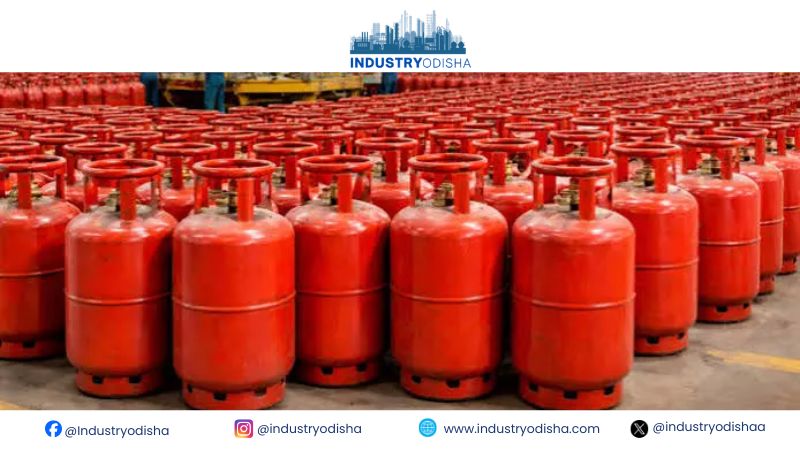
Industry Odisha Bureau, Aug 17: The Petroleum and Natural Gas Ministry has established facility-specific LPG production targets spanning twenty-one refineries and upstream companies nationwide. The government’s new framework specifies combined daily LPG production potential of sixty-three thousand eight hundred ten tonnes daily. This capacity represents more than double India’s domestic LPG output during fiscal year twenty twenty-five to twenty twenty-six. Reliance Industries’ Jamnagar domestic refinery has been assigned the largest individual production target of eighteen thousand tonnes daily. The policy directly reflects lessons learned when the West Asia conflict disrupted critical LPG supply routes through Hormuz.
India consumed thirty-three point two million tonnes of LPG during the previous fiscal year, approximately ninety-one thousand tonnes daily. Domestic refineries and upstream producers generated only thirteen point one million tonnes annually, roughly thirty-five thousand nine hundred tonnes daily. This meant India imported twenty-one point three million tonnes annually, representing approximately fifty-eight thousand four hundred tonnes every day. The country’s import dependence exceeds sixty-four percent, creating significant vulnerability to disruptions in overseas LPG supplies. Approximately ninety percent of India’s LPG imports originated from nations like Saudi Arabia through the Strait of Hormuz.
When West Asia conflict effectively closed the Strait of Hormuz, India faced immediate pressure on household and commercial LPG supplies. The government responded by ordering refineries to divert petrochemical production streams toward maximizing available LPG output throughout the crisis. During the emergency, domestic LPG production reached approximately fifty-five thousand tonnes daily at peak capacity levels. Initially, supplies to industrial and commercial users faced restrictions while domestic household allocations remained prioritized during acute shortages. Government later gradually increased supplies to commercial users as overseas import conditions began improving from mid-June onward.
The new permanent framework extends beyond temporary emergency measures adopted during the crisis period just experienced. The Petroleum and Natural Gas Ministry issued the order on August thirteenth, establishing standing production targets for individual refineries. Eighteen public-sector refineries have been assigned combined daily production targets of thirty-one thousand four hundred seventy tonnes daily. Russia-backed Nayara Energy’s Vadinar refinery in Gujarat received a target of four thousand four hundred eighty tonnes daily. Upstream gas producers ONGC and GAIL together face targets of six thousand four hundred sixty tonnes daily production.
The new framework requires all covered companies to maintain adequate infrastructure for LPG storage, evacuation, and transportation facilities. Companies must develop infrastructure either independently or through partnerships with railways and road tanker operators nationwide. The government has mandated pursuit of technically and economically feasible production upgrades across all refineries covered. Potential upgrades include naphtha-to-LPG conversion and fluid catalytic cracking unit modifications where economically viable for operators. These infrastructure and technology enhancements aim to maximize LPG production beyond current minimum producible quantities specified therein.
The government has empowered itself to issue binding production directions during supply constraints or public-interest scenarios. The Petroleum and Natural Gas Ministry can order refineries, oil marketing companies, and upstream producers to increase LPG output. Such directives may specify quantities, time periods, and compliance requirements for affected energy companies nationwide. Production schedules will be updated every six months on January first and July first each calendar year. Updates will account for new refineries, upstream companies, infrastructure improvements, technology enhancements, and distribution network changes forward.
This standing LPG production framework represents India’s strategic response to demonstrated energy-supply vulnerability discovered during recent geopolitical disruption. The policy prioritizes domestic resilience and reduces susceptibility to sudden overseas supply shocks affecting household and industrial users. Future disruptions to international LPG supplies should not trigger rationing, emergency restrictions, or severe household supply pressures again. India’s framework strengthens its energy security posture through deliberate domestic production capacity planning and infrastructure development investments.
